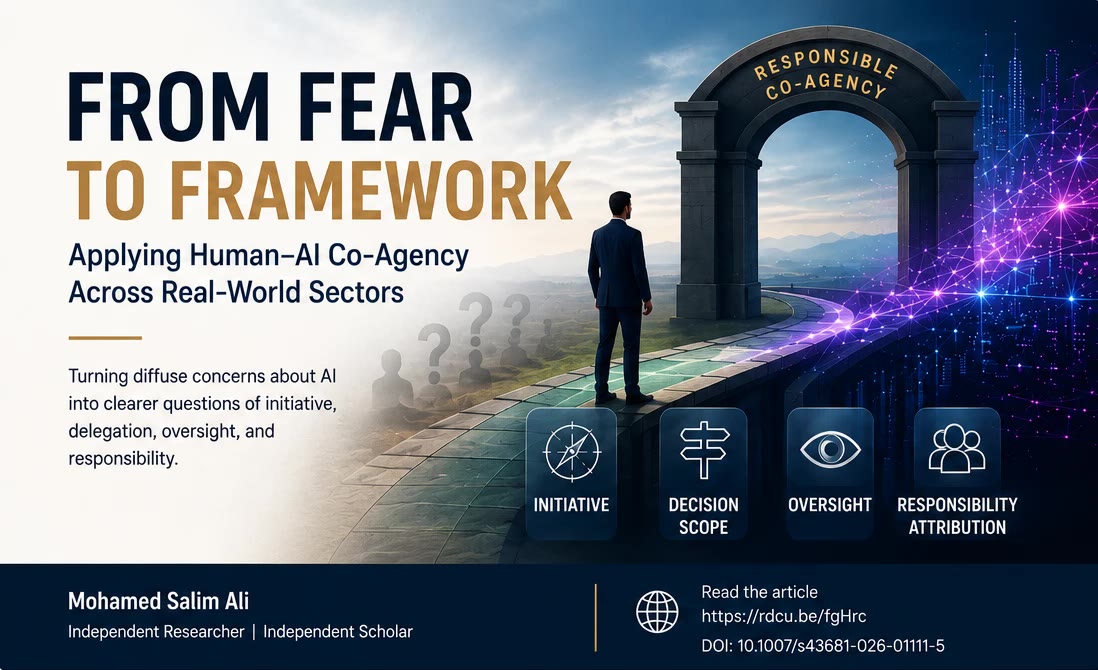

My research article, “From Assistants to Agents: A Relational Framework for Human–AI Co-Agency”, is published in AI and Ethics (Springer Nature). It addresses a central question of our time: as artificial intelligence evolves from assistive tools into increasingly agentic systems, how should we rethink human agency, delegated autonomy, oversight and responsibility?
Here is the reflection I shared on Springer Nature Research Communities about why I wrote it.
Between the tool and the autonomous actor
When we talk about artificial intelligence, much of the debate still oscillates between two familiar images. On one side, AI is treated as a sophisticated tool: something that supports human action but remains external to responsibility. On the other side, AI is sometimes described in near-anthropomorphic terms, as if it were becoming an autonomous actor in its own right. Both views, in different ways, seemed incomplete to me.
What increasingly interested me was a more difficult question: what happens when AI is neither merely assistive nor fully autonomous, but instead operates within structured systems of delegation, supervision and institutional responsibility? In other words, what happens when action is distributed across humans, artificial systems and governance structures?
Thinking about agency relationally
The central intuition behind the article is simple: the rise of agentic AI requires us to rethink agency relationally. In many real-world settings, AI does not act in isolation. Its apparent initiative is enabled, bounded and interpreted through human decisions, institutional goals, technical design and governance mechanisms. This means that responsibility cannot be understood by looking only at the machine, or only at the individual user. It has to be understood through the structure of the broader sociotechnical system.
To make that argument more operational, I proposed a four-dimensional framework:
These dimensions are intended to help clarify where delegation begins, how far it extends, how supervision is preserved, and how accountability should remain anchored even when systems take on greater initiative.
A bridge between theory and institutions
One reason I felt this mattered is that discussions about AI governance often remain either too abstract or too procedural. We speak in large terms about ethics, trust, regulation and policy, but we often lack a practical conceptual bridge between theory and institutional design. I wanted this work to contribute to that middle layer: not only asking what AI is, but how human–AI arrangements should be evaluated when decisions, actions and consequences are distributed.
I was also concerned that the vocabulary of “autonomy” can sometimes obscure more than it reveals. The issue is not simply whether a system appears autonomous. The more important question is whether institutions remain capable of structuring delegation responsibly. A system may appear highly capable while still depending on weak governance. Conversely, human accountability can be eroded not because humans disappear, but because roles, boundaries and responsibility structures become blurred.
In that sense, the challenge posed by agentic AI is not machine agency in isolation. It is the alignment of delegated action with meaningful human oversight and institutional responsibility. I hope this work contributes to a more grounded and rigorous conversation about how societies, organizations and governance systems should respond as AI becomes more agentic.
Read the article
- Full article (SharedIt): https://rdcu.be/fgHrc
- DOI: https://doi.org/10.1007/s43681-026-01111-5
- Behind the Paper on Springer Nature Research Communities: https://go.nature.com/3RhMXNE
*Mohamed Salim Ali is an independent researcher in AI ethics, philosophy of technology and governance, CEO of Og Innovation and co-founder of Ranza SARL.*